
Meet Vicki Aimers, a PhD Researcher at Falmouth University. In her work investigating the Lanyon family she has uncovered curious family stories about the navigation skills of Margaret Lanyon.
Vicki shared her findings with us and has inspired us to revisit our archives in search of women pilots and their stories.
I work with quiet objects – things that were never meant to be loud or take up space. Stitched samplers made by young girls in nineteenth-century Cornwall sit at the centre of my practice and doctoral research. These patient works, made slowly in classrooms and domestic spaces, carry traces of learning, discipline, care, and expectation. When I encounter one, I am always aware that it once passed through a child’s hands, guided by a teacher and shaped by the social and labouring worlds around her.
Currently, I am undertaking a practice-based PhD with Falmouth University. My research brings together feminist material culture, archival enquiry, and participatory making. I approach samplers not simply as historical artefacts, but as material traces of lived experience – evidence of how girls were taught, corrected, encouraged, and prepared for adult responsibilities. My work moves between heritage collections, studio practice, and community workshops, where historical objects are brought into conversation with contemporary lives. Making is not an illustration of ideas that already exist; it is how ideas form.
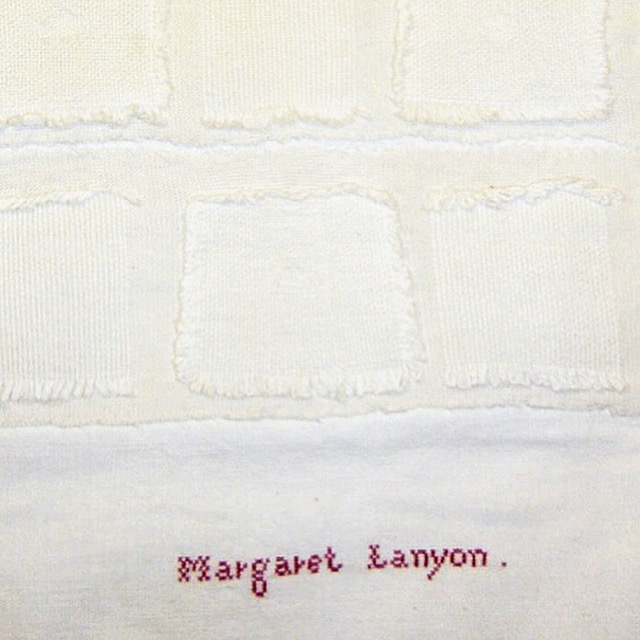
One sampler in particular has stayed with me. Made around 1879 by a young girl named Margaret Lanyon (1861–1939, attended Mawgan Board School, St Mawgan in Meneage), it is now held in the collection of the Cornwall Museum & Art Gallery, Truro. At first glance, it is a modest and carefully worked piece of plain darning – thread woven in and out to strengthen worn cloth. It was awarded a prize in 1879, recognised as an example of excellence, at a time when institutions such as an educational school board who gathered at The Polytechnic in Falmouth promoted needlework as an essential skill for girls. The sampler speaks of patience and precision, but also of expectation – of what young girls were trained to carry into adulthood. The longer I spent with it, the more it opened into a much larger story: one that moves between needlework and the sea, between schoolroom discipline and physical labour, and between family, land, and maritime life.
Margaret was born in Constantine into a close family network: her father Richard, mother Ann (née Semmens), sister Mary (who remained unmarried), and brother Richard, who later emigrated to Australia with his wife Kate (née Jordan). Her early years were shaped not only by domestic expectations, but also by the rhythms of nearby Gweek’s boatyards. Her father worked in haulage, delivering coal and timber, before later becoming an omnibus driver in the Wendron area – shifts that reflect wider changes in transport and labour in nineteenth-century Cornwall.
Alongside her needlework, Margaret appears to have developed a strong relationship with the sea. Family accounts suggest that she piloted boats along the Cornish coast and would, when needed, take over from the captain, navigating tides with confidence along the Gweek estuary. For a young woman in the late nineteenth century, this was both highly skilled and unusual, requiring calmness, decisiveness, and deep local knowledge. It places her firmly within Cornwall’s maritime culture, extending her story beyond the expectations held within the sampler itself.

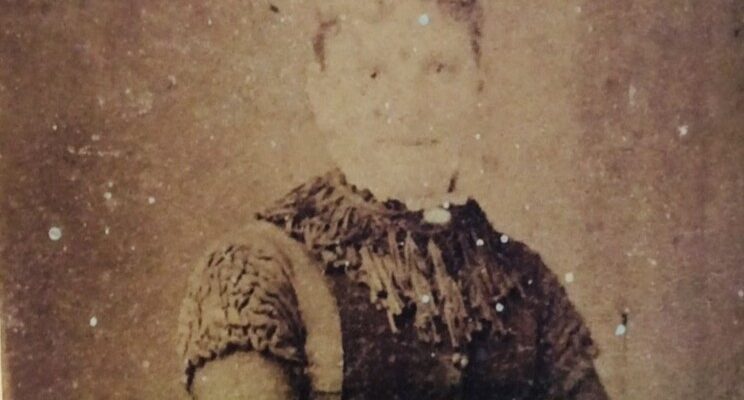
Margaret Lanyon, possibly around the time of her marriage.
Photo credit: Pearce Family Collection
A few years later, Margaret met her future husband, John Albert “Jack” Pearce, at a local music event. He played in a band and came from a farming family in Wendron. The Pearce farm in Wendron includes a prehistoric standing stone, which the brothers raised into position, placing coins beneath it for good luck – an act that draws together family, land, and time. The family continue to live and work on this land today.
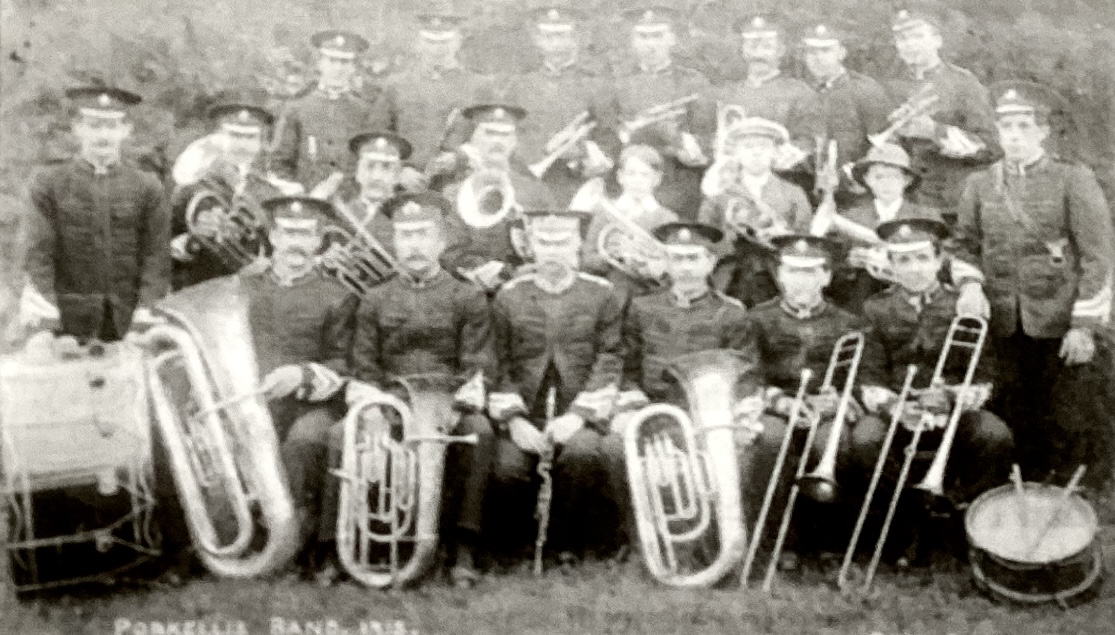
Porkellis Band – John Pearce, seated bottom left.
Photo credit: Pearce Family Collection
The Pearce brothers were active in competitive Cornish wrestling, a sport closely tied to regional identity, and John was recognised as a “Champion of Cornwall” for at least five years. One of his engraved wrestling belts remains within the family. If Margaret’s sampler reflects the disciplined and often private skills expected of girls, her marriage situates her within a more publicly celebrated culture of physical strength and competition.
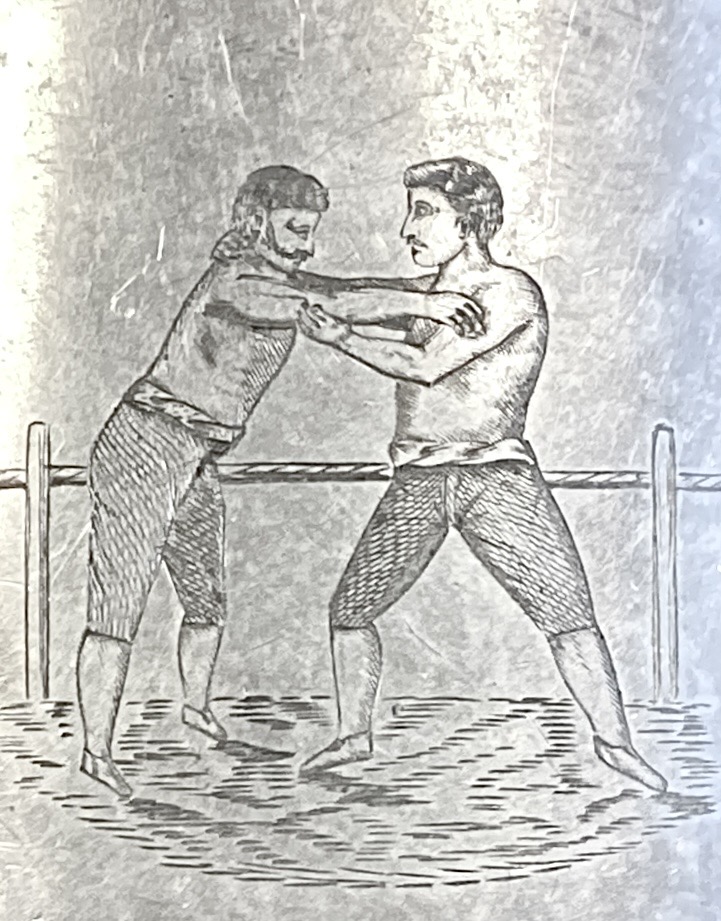
Detail from John Pearce’s wrestling belt
Photo credit: Pearce Family Collection
Margaret and John married in Wendron on 14 January 1886 and had four children. One son, William, died in infancy, and John himself died young, at around thirty-four, possibly while competing in America. Margaret later lived in Tuckingmill with her daughter Gladys until her death in 1939.
Her story holds together a series of contrasts: the careful discipline of creating a sampler, the confidence of maritime skill, the endurance of farming and wrestling culture, and the persistence of family ties. Together, these form a life shaped by skill, resilience, and a deep connection to Cornwall’s social and working histories.
As part of my research, I am seeking further information about the Lanyon family, particularly their maritime connections. I would be very grateful for any knowledge, photographs, documents, or oral histories that might help extend this story. Even the smallest fragment may be invaluable. If the name Lanyon connects with your own research or family history, I would be very glad to hear from you.
You can contact me via email at vickiaimers@btinternet.com, on Instagram @vicki_aimers, or through my university profile: https://www.falmouth.ac.uk/research/researcher-community/vicki-aimers .

No Comments on "Margaret Lanyon – A Cornish Pilot?"