
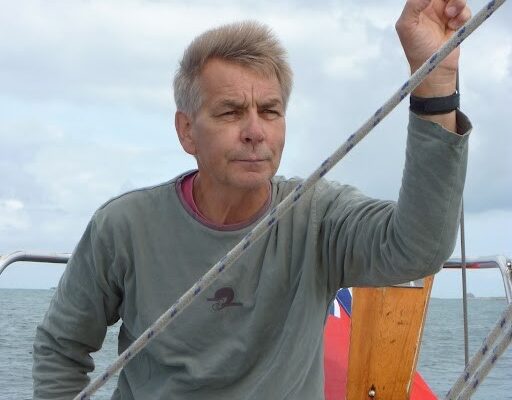
With the passing of Peter Frederick Niels Martin, the world of rowing and traditional gig building has lost one of its most quietly profound figures. Pete wasn’t one for loud declarations or fanfare, but his impact on the water, in the workshop, and within his community, was nothing short of immense. A craftsman, competitor, mentor, and friend, Pete’s legacy is carved not only in the wood of the gigs he built but also in the hearts of those lucky enough to row beside him, learn from him, or simply know him.
Born in Falmouth during the infamous snowstorms of March 1947, Pete’s early life was a fight; first against pneumonia, and later against the expectations others had for him. As a child, he could often be found on or near the water, bailing out punts, sailing with his grandfather on the Windstar, or racing skiffs around Greenbank Quay. His first rowing trophy dates back to 1958, just the beginning of a remarkable rowing career that would span decades.
A true competitor, Pete played rugby for Falmouth and also was picked to play for Cornwall, but misfortune in the form of a broken leg intervened. A tribute from Falmouth Rugby Club described Pete’s game, “his remarkable contributions on and off the field left an indelible mark during the mid-60s to early 70s”.
Though quiet and modest, Pete’s prowess on the water was unmistakable. A keen sailor, Pete raced Falmouth Working Boats, Sunbeams and enjoyed trips further afield. Whether in flash boats, skiffs, or sliding seat fours, he was a force to be reckoned with. At Greenbank Rowing Club, he was a central figure during its formative years, helping lead the club to historic victories in the early 1970s, including the prestigious South Coast Championships. His contributions helped pave the way for the club’s entry into Henley Royal Regatta, a first for a Cornish crew and a milestone in rowing history. Alongside crewmates like Ron Coote and Charlie West, he elevated Cornish rowing to new competitive heights. As Ron would later write, “Peter Martin was always one of my role models and an inspiration to me.”
Rowing gigs, Peter enjoyed success at the Newquay County Championships. But it wasn’t just on the mainland where Pete left his mark. When he moved to the Isles of Scilly in 1987, the style and standard of rowing across the islands began to shift. Pete brought structure, training, and an athlete’s mindset. Those who rowed with Pete, particularly his 1991 crew, speak of him with fierce admiration and affection.
After leaving school, Pete worked at Enterprise Boats where he worked for three years before undertaking a five-year apprenticeship at Mylor Dock Yard which included block release at Falmouth Tech (now The Marine School). After a period at Dredge Marine, he worked with Ralph Bird at The Ocean Youth Club, building 72ft ketches. They collaborated outside of the workplace, with Pete helping Ralph take the lines off the Treffry (shaping the specification of registered Cornish Pilot Gigs) and building the 15ft skiff, Green Adder, at Carnon Mine.
Pete moved to the Isles of Scilly in 1987 where his skills were in high demand maintaining island vessels. In the 1990s Alfred Hicks approached him to build a Camaret Crabber. The challenging build became the first of a number of projects including Seahorse, a 60-foot passenger launch which was built with timber from the Balmoral Estate. Shortly after, Pete was approached by Alan Cargeeg to build a gig for Mounts Bay. Pete built Storm, his first of what would be 13 Cornish Pilot Gigs including Taran, Morlader, Emperor, Kensa, Emma Louise, Phantom, Vleigende Hollander, Alfie Jenkins, Cormoran, Tregarthen’s and Zeeheld. The final gig, Carrick, of Truro River Rowing Club, was built with his grandson, Dylan.
As a boatbuilder, Pete’s name became synonymous with quality and tradition. But building boats was never just about the wood and tools for Pete, it was about people, about purpose. The boats he built continue to serve communities, bringing people together. He enjoyed long friendships with clients, other builders, and the CPGA Standards volunteers. When he returned to the mainland, Pete left the building and maintenance of island boats in the capable hands of Andrew Hicks, who had worked with Pete for 18 years.
Pete enjoyed a rich family life with his wife Fiona, children Rebecca and Nicholas, stepchildren Richard and Tex, and his treasured grandchildren. Together with Fiona, he restored boats like Cygnet and Shuna of Melfort and turned the Garrison House B&B into a welcoming place for visitors and rowers alike. In retirement in Gweek, he continued to live near the water.
Despite many serious accidents and a long battle with cancer, Pete’s resilience never wavered. It’s impossible to sum up all that Pete gave to rowing, to Scilly, to gig building, and to those around him. But the ripples of his life’s work will continue for generations, not just in the boats he built, but in the way he inspired others: to row harder, to build better, and to live with quiet determination and integrity.
We extend our deepest condolences to Fiona, the Martin family, and all who loved Pete. In recent weeks, there have been silent tributes to Pete, with oars raised at regattas around the coast. The gig rowing community both mourn and celebrate his extraordinary life.

No Comments on "Peter Martin: A Tribute"