

We have been following this project over the past year and have been fascinated by all the amazing findings. Thanks to Cathy Parkes from Cornwall Archaeological Unit for this end of project update.
Porths and Gigs of the Isles of Scilly, archaeology of the roots of gig racing
Results of this archaeological project are out now, tracing the roots of gig racing on Scilly where gigs were kept to speed pilots out to ships off the hazardous coasts. The team from Cornwall Archaeological Unit (CAU) present inter-active 3D virtual models, plan drawings, photos and stories of sites ─ freely available on a project website, and in a report which can be downloaded from the website here.
The ‘gig archaeology’ dates from the 1700s or even earlier, when the gig sheds, like the houses on Scilly, had thatched roofs. It ranges from parts of old gigs, scanned thanks to St Mary’s boatbuilder Andrew Hicks, to whole porths laid out as bases for gig pilotage that show strategic siting for reaching the rocky western approaches.
Information has come together from people on Scilly, from Victorian maps, and from traces on the ground – some sites had already come and gone before the maps were made. Altogether it indicates there were as many as 90 old gig sheds, in 60 different places (some being in groups), and there are visible remains of around half of their sites.
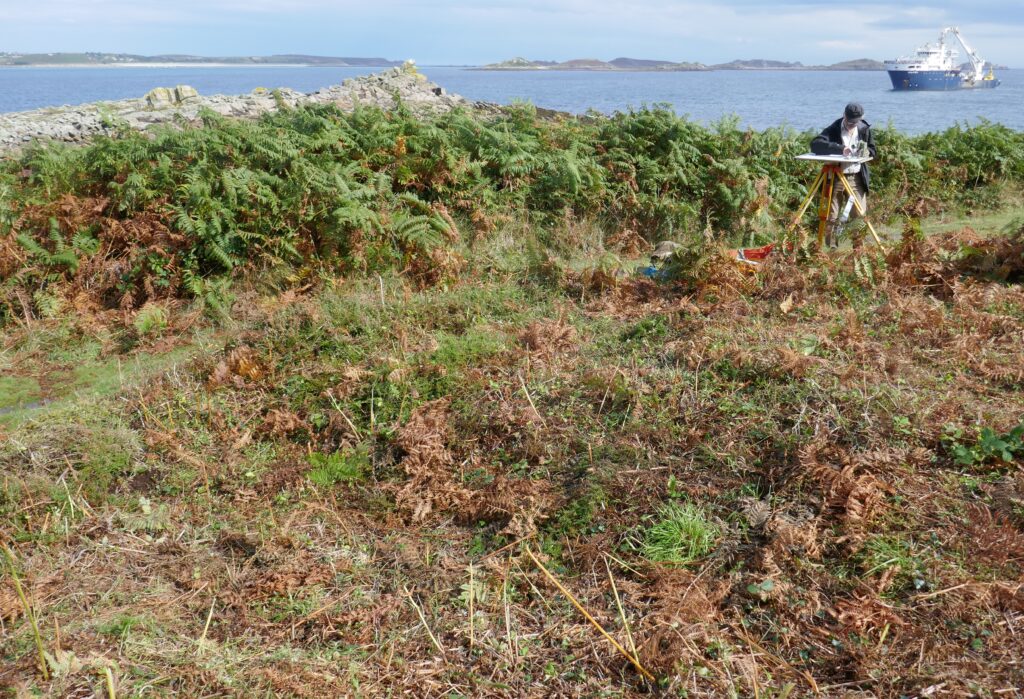
Project surveyor Mark Bowden records banks of an ancient gig shed, Innisidgen, St Mary’s. Photo credit: Cornwall Archaeological Unit
Half of the sites where there are remains, about 22 sheds, are linked to particular gigs still known by name. Some of these are former sheds of the 8 historic pilot gigs preserved on Scilly; gigs that saved ships and lives in the past, including those like Slippen or Czar that are still racing and competing in the annual World Championships held here at the present day.
It’s striking, as an indication of the scale of the heritage of gig pilotage on Scilly, that the total of gig sheds of all periods indicated here, 90, is similar to the number of the traditional-style gigs that come to race at the yearly Championships. During this year’s event The Guardian picked up some of the strong connections, explored by the project, between the sport and its heritage on the islands, publishing this article.
Some of the early sheds now appear as banks of sand and turf, where their walls stood. Others have walling up to roof height. Several have been restored, and another survives under a modern roof at Porth Cressa, in Hugh Town, next to the Dibble and Grubb restaurant that’s often full of rowers today!
Beyond the sheds, the gig archaeology even extends under the sea, at high tide. ‘Drangs’ or trackways were made, for the pilot crews to carry the boats to launch through the rocks exposed at low water. Drangs were kept free of boulders, and flanked with stone facing, and are mostly still quite clear. The ‘Porths and Gigs’ project scanning work was timed for the extreme low tides of 2024; so these remarkable features, which can be as much as 80m long, can be virtually explored as part of several of the 3D models online.
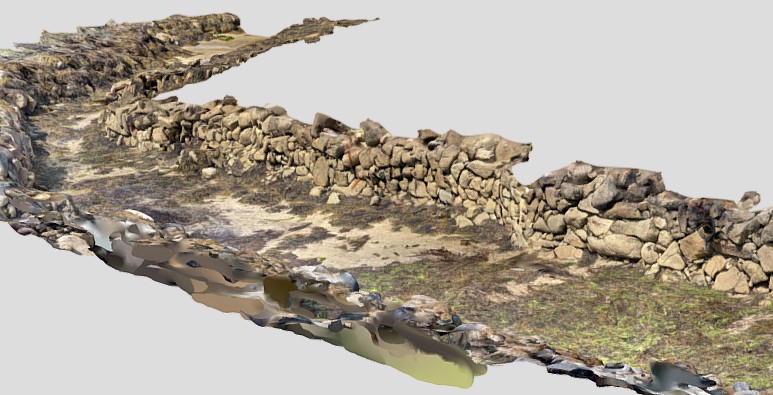
Lidar model by Tom Goskar of the way used for gigs at New Quay, St Mary’s, fully exposed at very low water. Photo credit: Cornwall Archaeological Unit
The full report on the ‘Porths and Gigs’ results can be downloaded at no cost, via the website here. Alternatively, by emailing enquiries@cau.org.uk , you can order a printed bound copy at A4 in full colour, at a cost of £17.50 to cover expenses of printing and postage.
This project has been funded by Historic England (HE), FiPL (Farming in Protected Landscapes), and CAS (Cornwall Archaeological Society), and supported by landowners the Duchy of Cornwall and Tresco Estate. Half a dozen of the gig sheds are Scheduled Monuments, but several of these are listed as ‘At Risk’ by HE, due to costal erosion and sea-level rise; the ‘Porths and Gigs’ project provides a record of these sites and focuses on their meanings. The work was helped greatly also by other organisations and individuals, the CPGA among other partners helping share the results.

No Comments on "Porth and Gigs Archaeology – Final Project Update"