

John Hicks QC, son of a Scilly islander and great-nephew of the pilot killed in the wreck of the Thomas W. Lawson, has written a new book about this famous incident.
Towards sunset on Friday, 13 December 1907, the largest sailing vessel in the world, named after the deeply superstitious Boston stockbroker who had a major financial stake in her, reached the mouth of the English Channel after a stormy first transatlantic crossing, and with another gale brewing. Thinking themselves well clear of any land the crew of the Thomas W. Lawson realised, too late, that they were among the rocks and shoals of the Isles of Scilly, 28 miles off Land’s End, and hurriedly anchored. In the night there was a violent storm, and by the small hours of the following morning the huge schooner was a wreck. At daylight a six-oared island gig was launched into a still high sea to search for survivors, and by the end of the day, after three perilous trips among the rocks, had rescued the only three. Of the 17 men from the tiny island of St Agnes who went out in their lifeboat to the Lawson on the 13th or in their gig to search the rocks on the 14th or who (in four cases) were involved in both ventures all but one were related and 13 bore the same surname. One of them was aboard her as pilot when she went down, and was killed.
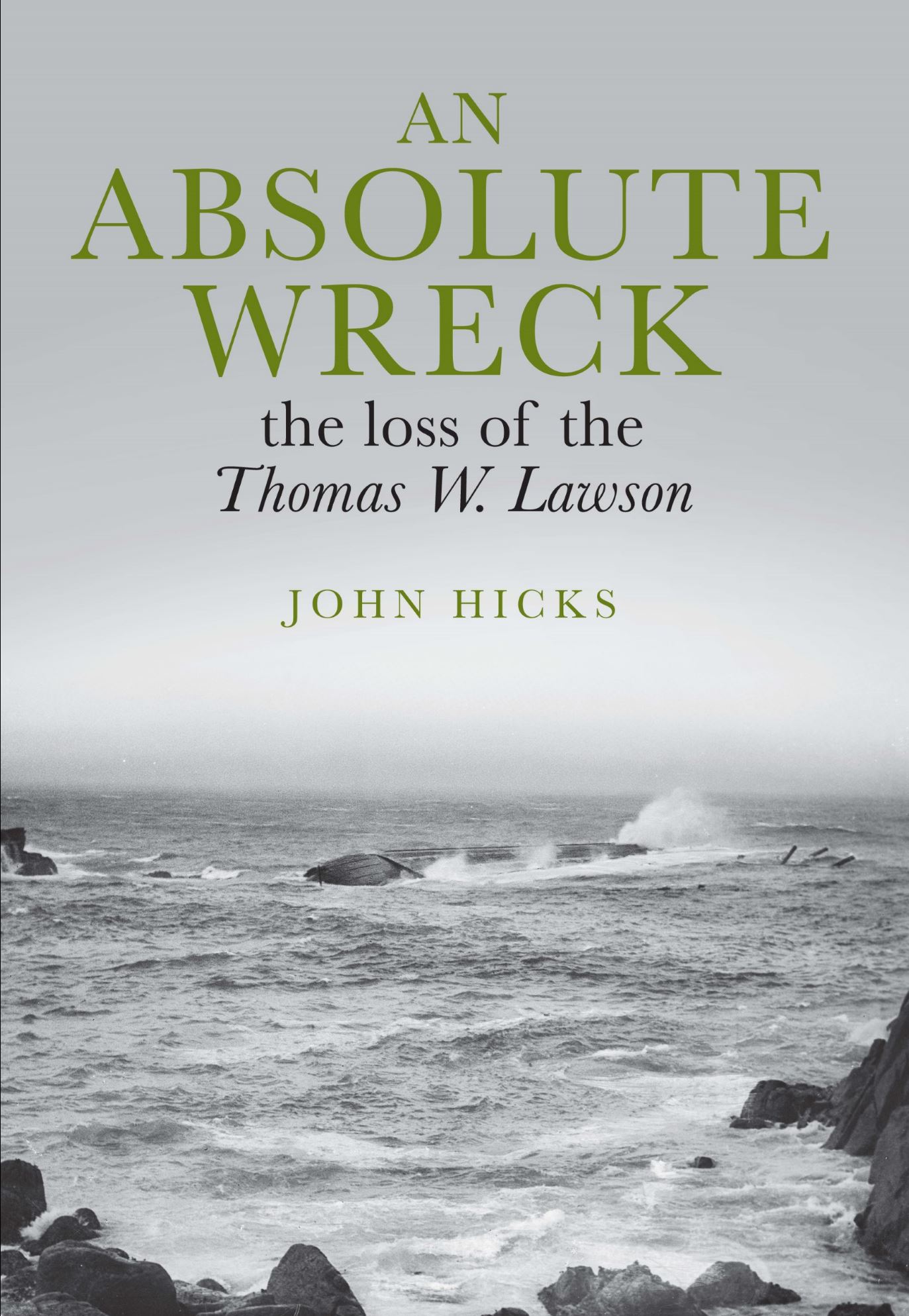
There have been many accounts of the wreck of the Thomas W. Lawson, but for such a familiar story there are a surprising number of contradictions among them, of apparent gaps in the narrative and of lapses of attention by commentators to significant issues, as well as several (not so surprising) differences of opinion on those which have been discussed. This book goes back, wherever possible, to original sources, written and oral, to address those difficulties, and also fills in the backgrounds without which neither the unique vessel involved, the man after whom she was named, nor the small, close-knit community into which she irrupted, let alone the impact which each had on the others, can be adequately understood. On the central question of what blame attaches to the Lawson’s master, Captain George W. Dow, it produces a new piece of evidence and reaches an unfashionable conclusion.
The author, John Hicks, told GigRower “In addition to more general matters the feature of particular interest to gig rowers is that the rescue of survivors by the men of St Agnes was effected, not in the lifeboat then stationed on the island, but in a working pilot gig, the Slippen, and the chapter dealing with that aspect includes a short general account of the history of the Cornish pilot gig and its unique qualities. There is also, in the chapter on the islands generally, an account of the use by the men of Bryher of the gig Albion in the rescue of the survivors of the wreck of the Delaware.”
The Author
His Honour John Hicks QC had a career as a solicitor before transferring to the bar, later being appointed a Circuit Judge and finally ending his working life as a Judge of the Technology and Construction Court. He brings his experience in assessing complex and contradictory webs of evidence to the description and attempted resolution of the many issues in this story. Of even greater importance, certainly to his interest in the events described, he is directly related to all but one of the St Agnes islanders, men and women, who played central parts in them. He is the great-nephew of the pilot killed in the wreck and holds the gold medal presented by the US Congress to his grandfather as one of the crew of the rescue gig. Although a landlubber himself he is the son of an islander and thus comes from an unbroken line of boatmen and seafarers extending over some ten or more generations, part of whose lore he has endeavoured to absorb.
Publication details
Title: An Absolute Wreck – the loss of the Thomas W. Lawson
Author: John Hicks
Publisher: Scotforth Books, on behalf of the author
ISBN: 978-1-909817-25-8
Date: 2015
Price: £15.00
Obtainable from the author, at Flat 3, 17 Montagu Square, London W1H 2LE,
john.hicks@montagusquare.net

This book tells an excellent story and carefully and forensically unravels a mystery about the loss of a unique ship. It is also a product of experiences and interests from the author’s own remarkable story, drawing on his outstanding qualities as a lawyer and judge and his long family traditions in the Scilly Isles.